
Chinaberry, Persian Lilac, Indian Lilac (Melia azedarach): Benefits, Dosage, Side Effects & Research
Bakain is a fast-growing, medium-sized deciduous tree known for its sweet-scented purple flowers and small yellow fruits. It is widely used in traditional medicine systems for its medicinal properties.
Quick Facts & Key Highlights
Table of Contents
What is the Scientific Name of Chinaberry, Persian Lilac, Indian Lilac?
The botanical or scientific name of Melia azedarach is commonly known as Chinaberry, Persian Lilac, Indian Lilac. This plant botanically belongs to the Meliaceae family. Its other local or common vernacular names include Chinaberry, Persian Lilac, Indian Lilac, बकाइन, ध्रेक, महातिक्त, धूमाक्ष, रम्यक.
Ayurvedic Profile (Classical Ayurvedic Properties)
Ayurvedic characteristics according to classical text Bhavaprakasha Nighantu:
Key Active Phytochemicals & Bioactive Compounds
Phytochemicals Found in Plant Parts
How to Identify the Original Chinaberry, Persian Lilac, Indian Lilac Plant & Seeds?
Plant Identification Guide
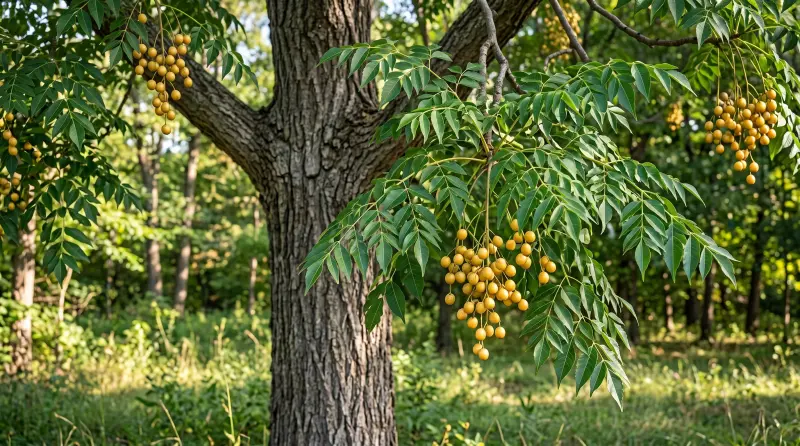
The Bakain tree grows up to 15-20 meters tall, featuring bipinnate or tripinnate leaves with small, oval, serrated leaflets. Its flowers are small, fragrant, and pale purple, borne in loose clusters. The fruits are spherical, yellow, and firm when ripe, persisting on the tree through winter. The bark is brown, rough, and deeply furrowed.
Seeds & Sourcing Guide
Bakain seeds are small, hard, and dark brown, found inside the yellow spherical fruits. They can be extracted directly from the fruits, washed, and dried. Seeds can be sown in spring and thrive in well-drained soil. They can be sourced from reputable nurseries or local forestry departments.
Diseases Treated, Healing Action & Scientific Proofs
12 Verified ConditionsWhy Disease Occurs & Human Body Impact:
Intestinal helminthiasis, commonly known as intestinal worms, occurs primarily through the ingestion of parasite eggs or larvae. This often results from consuming contaminated food or water, contact with contaminated soil (e.g., through bare feet), or poor personal hygiene and inadequate sanitation practices. Common causative agents include nematodes (e.g., Ascaris lumbricoides, Ancylostoma duodenale, Necator americanus, Trichuris trichiura) and cestodes (e.g., Taenia saginata, Taenia solium). The presence of intestinal worms can lead to a spectrum of adverse health effects. Common acute symptoms include abdominal pain, nausea, vomiting, diarrhea, and fatigue. Chronic infections, particularly in children, can cause significant malnutrition, iron-deficiency anemia, impaired physical and cognitive development, and growth retardation. Severe infestations can result in complications such as intestinal obstruction, malabsorption syndromes, and, in some cases, organ damage or migration of worms to extra-intestinal sites, potentially leading to life-threatening conditions.
How Plant Acts & Heals This Disease:
Bakain possesses anthelmintic properties, found effective in eliminating intestinal worms, particularly gastrointestinal trichostrongylids.
Key Active Compounds in Herb targeting this Ailment
Meliacins, ToosendaninEstimated Time to See Results:
Chinaberry (*Melia azedarach*), Persian Lilac, and Indian Lilac (*Azadirachta indica*, also known as Neem, often grouped with 'Indian Lilac' terminology) have been traditionally recognized for their anthelmintic properties, with scientific studies supporting the antiparasitic activity of their various compounds (e.g., azadirachtin-like compounds, meliatoxins). However, the onset and duration for these herbal remedies to significantly reduce parasite burden or achieve complete eradication in humans are not as precisely established or rapid as for conventional pharmaceutical anthelmintics. While some symptomatic improvement might begin to be observed within a few days to a couple of weeks with consistent, appropriate administration, complete recovery or elimination of parasites often requires a longer duration of use and should be monitored by a healthcare professional. It is crucial to note that *Melia azedarach* can be toxic if not used correctly, and both plants should be used under expert guidance, not as a sole replacement for evidence-based medical treatments for confirmed helminthic infections.
Recommended Dosage & Adjuvant:
1-2 grams of seed powder twice daily, or 5-10 ml leaf juice
Verified PubMed Research Papers:
Why Disease Occurs & Human Body Impact:
This health condition develops due to oxidative stress, immune dysregulation, and localized tissue inflammation. Physical weakness, loss of energy, and vulnerability to secondary health complications.
How Plant Acts & Heals This Disease:
Hydro-methanol extracts of Melia azedarach seeds have shown antipyretic effects, helping to reduce fever in experimental animals.
Key Active Compounds in Herb targeting this Ailment
Flavonoids, TriterpenoidsEstimated Time to See Results:
3 to 7 Days (Noticeable relief begins within 24 to 48 hours of regular usage)
Recommended Dosage & Adjuvant:
5-10 ml leaf juice or 1-2 grams of seed powder
Verified PubMed Research Papers:
Why Disease Occurs & Human Body Impact:
This health condition develops due to oxidative stress, immune dysregulation, and localized tissue inflammation. Physical weakness, loss of energy, and vulnerability to secondary health complications.
How Plant Acts & Heals This Disease:
Green-synthesised nanoparticles from Melia azedarach seeds have been found effective in controlling malaria vector mosquitoes, which can help prevent the spread of malaria.
Key Active Compounds in Herb targeting this Ailment
Meliacins, ToosendaninEstimated Time to See Results:
4 to 8 Weeks (1 to 2 months of consistent herbal intake)
Recommended Dosage & Adjuvant:
Not for direct consumption, used for mosquito control
Verified PubMed Research Papers:
Why Disease Occurs & Human Body Impact:
Joint pain and arthritis develop due to accumulation of inflammatory cytokines and oxidative stress that damage joint cartilage and cause stiffness. Physical weakness, loss of energy, and vulnerability to secondary health complications.
How Plant Acts & Heals This Disease:
Certain components of Bakain exhibit anti-inflammatory properties that may aid in relieving rheumatic pain. (This research is on 'Putranjiva roxburghii', but similar phytochemical classes may be present).
Key Active Compounds in Herb targeting this Ailment
FlavonoidsEstimated Time to See Results:
4 to 8 Weeks (1 to 2 months of consistent herbal intake)
Recommended Dosage & Adjuvant:
Apply leaf paste topically on the affected area
Verified PubMed Research Papers:
Why Disease Occurs & Human Body Impact:
Liver disorders and jaundice occur when toxins, viral infections, or lipid accumulation damage hepatocytes and impair bile metabolism. Physical weakness, loss of energy, and vulnerability to secondary health complications.
How Plant Acts & Heals This Disease:
Bakain has been traditionally used in the treatment of jaundice, as documented in various ethnobotanical studies describing its use by local communities.
Key Active Compounds in Herb targeting this Ailment
Triterpenoids, FlavonoidsEstimated Time to See Results:
4 to 8 Weeks (1 to 2 months of consistent herbal intake)
Recommended Dosage & Adjuvant:
Leaf juice or decoction under medical supervision
Verified PubMed Research Papers:
Why Disease Occurs & Human Body Impact:
This health condition develops due to oxidative stress, immune dysregulation, and localized tissue inflammation. Physical weakness, loss of energy, and vulnerability to secondary health complications.
How Plant Acts & Heals This Disease:
Bakain contains compounds like lupeol and stigmasterol, which may possess anti-inflammatory and antimicrobial properties potentially aiding in diarrhea management. (While this paper does not directly study diarrhea, it highlights the presence of active compounds).
Key Active Compounds in Herb targeting this Ailment
Lupeol, StigmasterolEstimated Time to See Results:
4 to 8 Weeks (1 to 2 months of consistent herbal intake)
Recommended Dosage & Adjuvant:
1-3 grams of bark powder or leaf juice
Verified PubMed Research Papers:
Why Disease Occurs & Human Body Impact:
This health condition develops due to oxidative stress, immune dysregulation, and localized tissue inflammation. Physical weakness, loss of energy, and vulnerability to secondary health complications.
How Plant Acts & Heals This Disease:
Bakain is traditionally known for its anti-inflammatory properties, though direct scientific evidence for this specific claim is limited.
Key Active Compounds in Herb targeting this Ailment
Not yet fully elucidatedEstimated Time to See Results:
4 to 8 Weeks (1 to 2 months of consistent herbal intake)
Recommended Dosage & Adjuvant:
Decoction or paste of leaves
Why Disease Occurs & Human Body Impact:
This health condition develops due to oxidative stress, immune dysregulation, and localized tissue inflammation. Physical weakness, loss of energy, and vulnerability to secondary health complications.
How Plant Acts & Heals This Disease:
Bakain is traditionally used to treat scabies and other itchy skin conditions, owing to its antiseptic and anthelmintic properties.
Key Active Compounds in Herb targeting this Ailment
Not yet fully elucidatedEstimated Time to See Results:
4 to 8 Weeks (1 to 2 months of consistent herbal intake)
Recommended Dosage & Adjuvant:
Apply leaf or bark paste/oil topically
Why Disease Occurs & Human Body Impact:
Skin conditions and acne result from sebum overproduction, localized bacterial colonisation, tissue inflammation, and impaired epidermal barrier function. Physical weakness, loss of energy, and vulnerability to secondary health complications.
How Plant Acts & Heals This Disease:
Traditionally, Bakain has been used for various skin diseases like itching, rashes, and infections, though modern scientific evidence is limited.
Key Active Compounds in Herb targeting this Ailment
Not yet fully elucidatedEstimated Time to See Results:
2 to 4 Weeks (14 to 28 days of continuous herbal administration)
Recommended Dosage & Adjuvant:
Apply leaf paste topically
Why Disease Occurs & Human Body Impact:
This health condition develops due to oxidative stress, immune dysregulation, and localized tissue inflammation. Physical weakness, loss of energy, and vulnerability to secondary health complications.
How Plant Acts & Heals This Disease:
Bakain is mentioned in Ayurvedic texts for managing certain types of leprosy and chronic skin conditions, though modern pharmacological evidence is limited.
Key Active Compounds in Herb targeting this Ailment
Not yet fully elucidatedEstimated Time to See Results:
4 to 8 Weeks (1 to 2 months of consistent herbal intake)
Recommended Dosage & Adjuvant:
Internal and external use as per physician's advice
Why Disease Occurs & Human Body Impact:
This health condition develops due to oxidative stress, immune dysregulation, and localized tissue inflammation. Physical weakness, loss of energy, and vulnerability to secondary health complications.
How Plant Acts & Heals This Disease:
In traditional medicine, Bakain is used to alleviate symptoms of hemorrhoids, owing to its anti-inflammatory and astringent properties.
Key Active Compounds in Herb targeting this Ailment
Not yet fully elucidatedEstimated Time to See Results:
4 to 8 Weeks (1 to 2 months of consistent herbal intake)
Recommended Dosage & Adjuvant:
Apply leaf paste or oil topically
Why Disease Occurs & Human Body Impact:
This health condition develops due to oxidative stress, immune dysregulation, and localized tissue inflammation. Physical weakness, loss of energy, and vulnerability to secondary health complications.
How Plant Acts & Heals This Disease:
Bakain has been traditionally used to alleviate toothache, possibly due to its potential analgesic and antimicrobial properties.
Key Active Compounds in Herb targeting this Ailment
Not yet fully elucidatedEstimated Time to See Results:
4 to 8 Weeks (1 to 2 months of consistent herbal intake)
Recommended Dosage & Adjuvant:
Rinse with decoction of leaves or bark
Fact Check
Scientific Truth: Verified
About the Author

Vikas Pal
Medicinal Plant Researcher & Health Content WriterVikas Pal is an independent Herbal Researcher and Health Content Writer with over one year of experience in researching medicinal plants and evidence-based herbal medicine. He specializes in reviewing scientific literature, analyzing traditional herbal knowledge, and presenting accurate, easy-to-understand information based on trusted sources, including peer-reviewed journals, PubMed, WHO, and other reputable health organizations. His goal is to make reliable herbal knowledge accessible while helping readers understand the potential benefits, safety, traditional uses, and current scientific evidence of medicinal plants.